
 A CFC@LDN Fan
Hi, my name is CHENG YE(程烨,程ヨウ). I am now a first year master student at the Kyoto University, where I conduct research in the Data Engineering and Platform Research Group, advised by Prof. Kazuyuki Shudo. I received my B.Eng. degree from the Kansai University, advised by Assoc. Prof. Adachi Naotoshi.
My research interests lie broadly in the Federated Learning, Blockchain and AI security. I am also interested in climbing, football, and working out.

Warning
Problem: The current name of your GitHub Pages repository ("Solution: Please consider renaming the repository to "
http://".
However, if the current repository name is intended, you can ignore this message by removing "{% include widgets/debug_repo_name.html %}" in index.html.
Action required
Problem: The current root path of this site is "baseurl ("_config.yml.
Solution: Please set the
baseurl in _config.yml to "Education
-
 Kyoto UniversityApril. 2026 - March. 2028graduate school of informatics
Master Student -
 Kansai UniversityApril. 2021 - March. 2026B.Eng. :Department of Civil, Environmental and Applied Systems Engineering
Experience
-
 Rakuten Group, Inc.Aug. 2026 - Oct. 2026Applications Engineer
Language
-
 Chinesenative
 -
 Japaneseconversational
 -
 Englishread & listen
News
Selected Publications (view all )
GOFA: Gradient-Oriented Backdoor Attack in Vertical Federated Learning
Ye CHENG, Adachi Naotoshi
International Conference on Electrial Computer and Energy Technologies 2026 ICECET2026
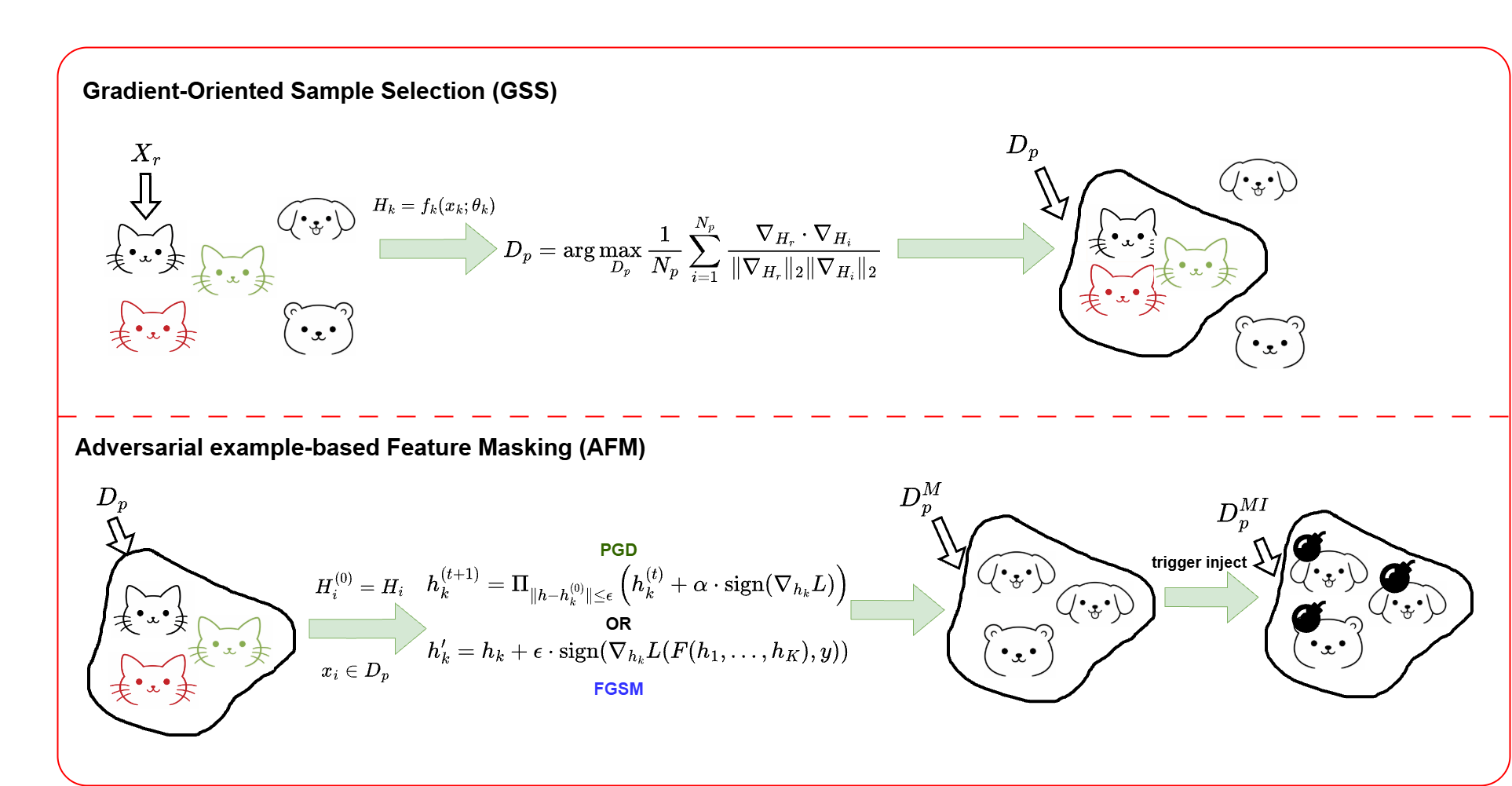
Vertical federated learning (VFL) enables multiple organizations with disjoint feature spaces and overlapping sample identities to collaboratively train machine learning models without sharing raw local data. Despite this privacy-preserving paradigm, VFL remains vulnerable to backdoor attacks. In particular, a malicious passive party can inject carefully crafted triggers into local inputs or intermediate embeddings, causing targeted mispredictions during inference. Existing VFL backdoor attacks (e.g., BadVFL) typically assume that the malicious client has additional knowledge of task labels, which conflicts with the core privacy assumptions of VFL. In this paper, we propose GOFA, a gradient-oriented backdoor attack for VFL. GOFA leverages server-provided gradient feedback to construct a poisoned dataset and applies adversarial-example techniques (e.g., FGSM) to mask original features and strengthen trigger learning. Experiments on CIFAR-10 and UCI-HAR demonstrate the effectiveness of our method across multiple settings.
GOFA: Gradient-Oriented Backdoor Attack in Vertical Federated Learning
Ye CHENG, Adachi Naotoshi
International Conference on Electrial Computer and Energy Technologies 2026 ICECET2026
Vertical federated learning (VFL) enables multiple organizations with disjoint feature spaces and overlapping sample identities to collaboratively train machine learning models without sharing raw local data. Despite this privacy-preserving paradigm, VFL remains vulnerable to backdoor attacks. In particular, a malicious passive party can inject carefully crafted triggers into local inputs or intermediate embeddings, causing targeted mispredictions during inference. Existing VFL backdoor attacks (e.g., BadVFL) typically assume that the malicious client has additional knowledge of task labels, which conflicts with the core privacy assumptions of VFL. In this paper, we propose GOFA, a gradient-oriented backdoor attack for VFL. GOFA leverages server-provided gradient feedback to construct a poisoned dataset and applies adversarial-example techniques (e.g., FGSM) to mask original features and strengthen trigger learning. Experiments on CIFAR-10 and UCI-HAR demonstrate the effectiveness of our method across multiple settings.